মঙ্গলবার ● ২৫ মার্চ ২০২৫
প্রথম পাতা » English » Tobacco Control Law should be Reformed in Line with WHO FCTC


Tobacco Control Law should be Reformed in Line with WHO FCTC
Press Release:
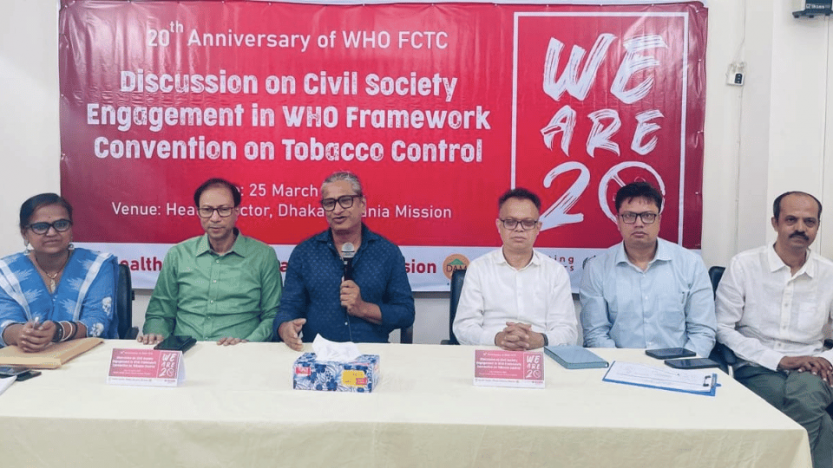
Dhaka, 25 March-2025: According to the World Health Organization, tobacco use is the leading cause of preventable death and disease globally, stated the speakers. Today, on Tuesday, March 25, at 3:00 PM, during a discussion meeting titled “Role of Civil Society in the Implementation of WHO FCTC” organized by Dhaka Ahsania Mission at the health sector office in Shyamoli, the speakers further mentioned, “Tobacco poses a significant barrier to public health protection and achieving SDG targets. Therefore, the proper implementation of FCTC and the participation of civil society are crucial to achieving the SDGs by 2030. To ensure the effective implementation of FCTC, it is essential to amend and enforce the tobacco control law strictly.”
The speakers included Iqbal Masud, Director of Health and WASH Sector at Dhaka Ahsania Mission, Syed Mahbubul Alam Tahin, Senior Technical Advisor at Vital Strategies, Aminul Islam Sujon, Technical Advisor, Saifuddin Ahmed, Executive Director of WBB Trust, Syeda Anonna Rahman, Head of Program, Md. Mokhlesur Rahman, Deputy Director of Health Sector at Dhaka Ahsania Mission, Md. Shariful Islam, Tobacco Control Project Coordinator, and Marzana Muntha, Coordinator of Ahsania Mission Youth Forum for Health and Wellbeing.
The speakers reflected on the invaluable role and contribution of civil society in the formulation, review, and implementation of the FCTC since its inception in 2003. They emphasized that civil society participation is undeniable in mobilizing the government for the development of tobacco control laws under the FCTC.
Iqbal Masud, Director of Health and WASH Sector, Dhaka Ahsania Mission, stated that on February 27, 2025, the WHO Framework Convention on Tobacco Control (WHO FCTC) marked its 20th anniversary. This is a legally binding international treaty first discussed by the World Health Organization, and it quickly became the most widely accepted agreement in the history of the United Nations. 183 countries, including Bangladesh, have signed and ratified this treaty, committing to reduce tobacco consumption, nicotine addiction, and second-hand smoking.
In Bangladesh, the tobacco use rate among people aged 15 and above is 35.3% (according to GATS2017). Every year, 161,000 people die from tobacco-related diseases, around 400,000 people become disabled, and 42.7% of the population is exposed to second-hand smoke. Despite the ban on tobacco product promotion and advertising, the lack of effective enforcement has enabled tobacco companies to use tactics and flashy advertisements, resulting in the increasing addiction of young people in the country. In this regard, the state must protect future generations from the grasp of tobacco companies and ensure this protection through appropriate laws and their strict implementation.
বিষয়: #control #Law #Tobacco


 BRAC Announces BDT 530 Million Self-funded Initiative for Agriculture and Social Welfare Microfinance Programme to invest around BDT 328.5 Million in agriculture
  V70 FE: Made for the Road Ahead
  Oil, War, and the Hypocrisy of Power–But Who Speaks for the Hungry Children of Bangladesh?
  Watch Bangladesh vs New Zealand, Pakistan & Australia Live on Toffee from April 17
  Banglalink introduces country’s first 5G Hajj roaming packs
  vivo V70 FE: Turn Photos into Aurora-Inspired Scenes
  Banglalink and Romoni Join Hands to Empower Women Digitally and Financially
  BPCCI shared the ‘Bridging Nations, Building Prosperity’ roadmap to strengthen Bangladesh-Philippines bilateral trade
  ‘TiffinBox’ Second Outlet Launched in Mohammadpur for Food Lovers
  HONOR introduces the X8d in Bangladesh to celebrate Pohela Boishakh